
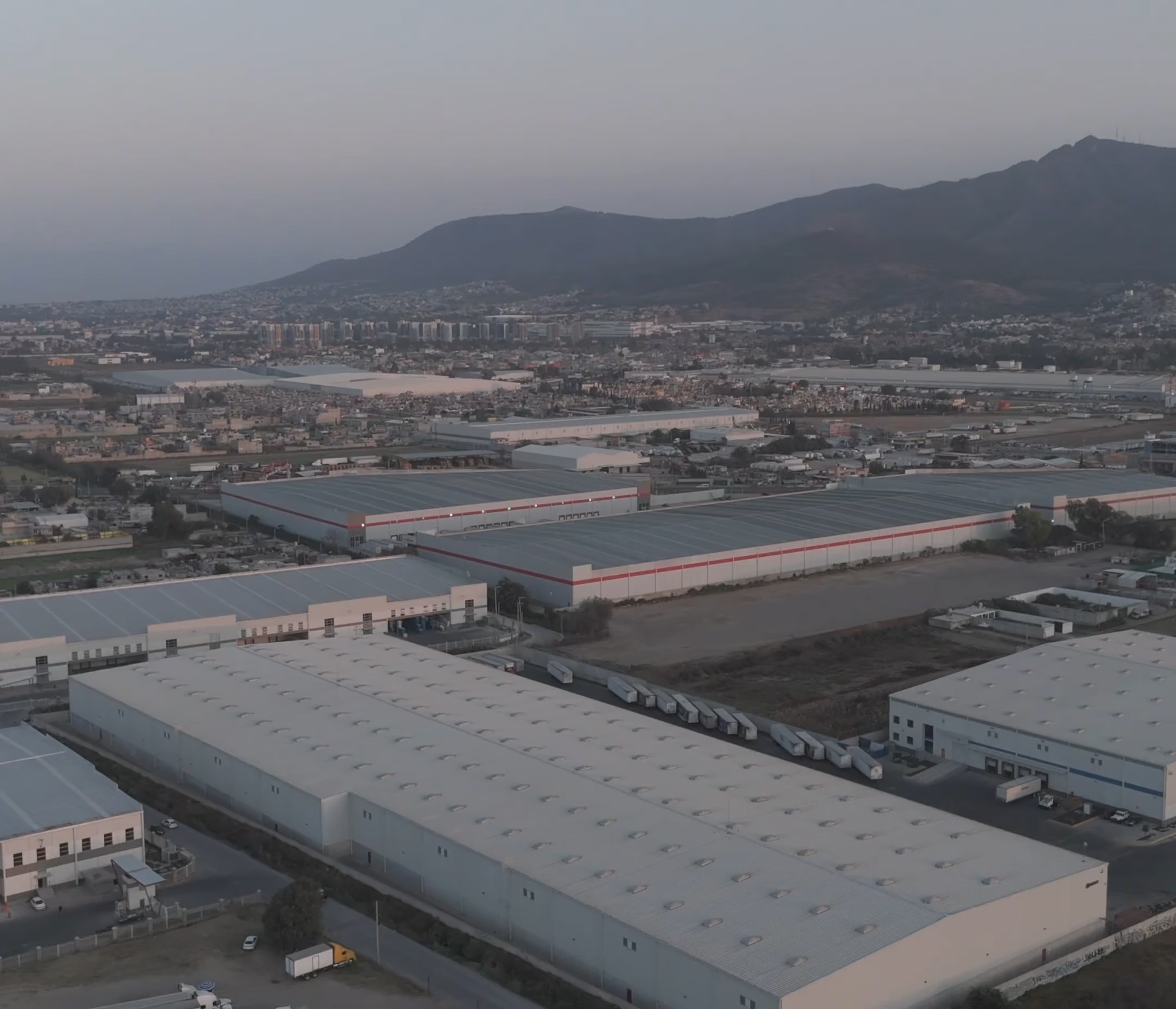
Support grid reliability and reduce energy costs
Distributed energy programs, including community solar, play a critical role in today’s energy landscape. These programs help reduce energy costs, strengthen grid resilience, and deliver new capacity where it’s needed most, faster than traditional infrastructure.
Solar Landscape partners with utilities, policymakers, and communities to deploy community solar projects that add meaningful local capacity to the grid while expanding access to energy savings for households, including renters and homeowners.
Built within existing distribution networks
New capacity can be delivered in as little as 12 months
Deploys power closer to where energy is consumed
%20(1).avif)
Empowering communities through
~energy cost savings~
Community solar expands access to affordable distributed energy, reduce costs for residents and ratepayers, and bring new local capacity online without requiring major infrastructure investment.
Solar Landscape partners with utilities, policymakers, and communities to deploy projects aligned with state programs that strengthen the grid and deliver measurable local impact.
Community solar programs require no upfront investment and broaden access to distributed energy savings across the communities they serve. Participation does not require rooftop installation or homeownership, helping expand access for renters, seniors, and low-to-moderate income households.
%20(1).avif)
Designed to align with state and local energy programs
Energy programs are not one-size-fits-all. While community solar has become an effective model in many states, other markets may require different program structures based on local policy frameworks, utility requirements, and energy needs.
Solar Landscape has extensive experience designing and operating distributed energy programs that align with state and local objectives—helping utilities, policymakers, and municipalities deploy solutions that support affordability, grid reliability, and renewable energy adoption.
Beyond project deployment, Solar Landscape manages customer operations across more than 100 projects through a sophisticated technology ecosystem built to support enrollment, administration, compliance, and long-term program performance at scale.
Experience across multiple state program structures
Alignment with local policy and utility requirements
Customer management across 100+ projects
Streamlined enrollment and administration
Scalable operational infrastructure
Proven deployment and long-term program management
%20(1).avif)
Built to manage
programs ~at scale~
Solar Landscape's technology ecosystem supports customer operations that serve 783 communities across three states, streamlining administration, improving performance, and supporting long-term scalability.
Platform Highlights
- Currently serving 783 communities across three states and on track to expand reach to 827 communities across five states
- Streamlines enrollment and administration
- Enhances long-term program reliability
- Improves participant experience at scale
~Case~
studies
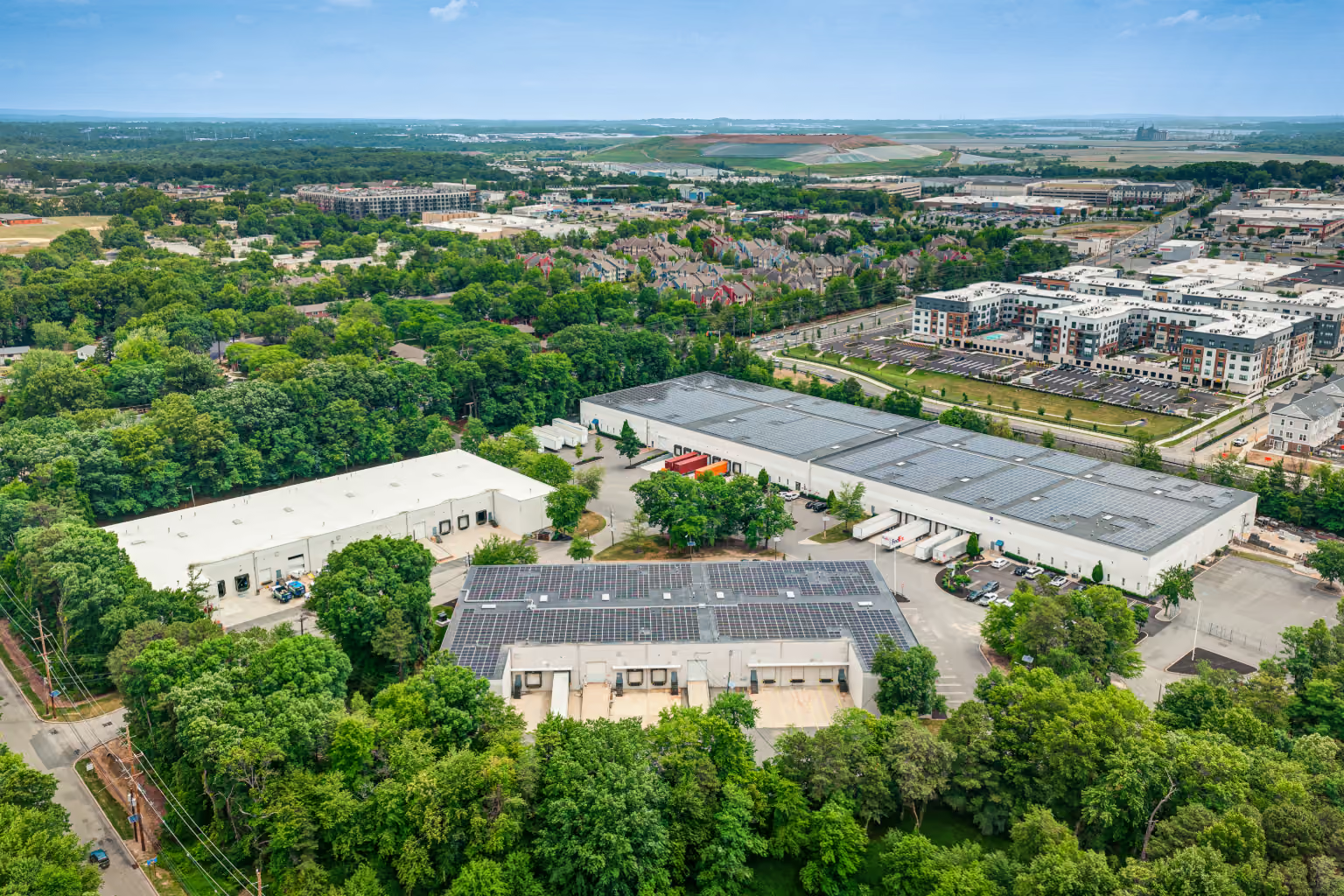
Public Storage monetized 13.2M sq ft of rooftop space with 208 community solar projects totaling 131 MWdc across five states.


~Delivering~ measurable value to communities
Community solar supports more than the grid—it helps create economic opportunity through workforce development, local partnerships, and scalable energy investment.
Supports local job creation
Expands workforce development opportunities
Reduces energy costs across communities
Strengthens long-term resilience
Proven execution, ~trusted by partners~
Solar Landscape works alongside utilities, policymakers, and commercial real estate owners to deliver community solar programs across multiple states. Proven across 500+ projects and 170+ partners, we combine execution expertise with advanced technology to bring new energy online efficiently while managing program complexity at scale.
Lower your ~electricity bill~
Explore available programs, eligibility, and enrollment options. Available for renters and homeowners. No panels required and no change to your utility provider. Clean energy with guaranteed savings.
Talk to Our ~Policy Team~
Communities across the country are looking for practical ways to meet growing energy demand, strengthen grid resilience, and expand access to affordable electricity. Solar Landscape partners with policymakers, municipalities, and public agencies to develop distributed energy solutions that support local priorities and accelerate infrastructure deployment.
Email: policy@solarlandscape.com
FAQs
Find answers to frequently asked questions about the role of distributed energy in meeting growing electricity demand, supporting communities, expanding grid capacity, and delivering reliable, affordable energy.
How does community solar benefit local residents?
Community solar gives households, renters, and businesses the opportunity to benefit from solar energy without installing panels on their own property. Participants subscribe to a local solar project and receive credits on their electricity bills for the energy the project generates.
For many families, community solar provides a simple way to lower monthly electricity costs while expanding access to clean, locally generated energy. By making solar available to more people, community solar helps states meet clean energy goals while delivering direct financial benefits to residents.
How can distributed energy support economic development?
Reliable electricity is essential to attracting new businesses, supporting industrial growth, and creating jobs. As electricity demand increases, access to power is becoming an increasingly important factor in economic development.
Distributed energy helps communities expand local electricity generation and grid capacity more quickly by leveraging existing commercial properties. Faster access to energy infrastructure can help support business expansion, manufacturing, logistics, data centers, and other industries that depend on reliable power.
How does commercial rooftop solar strengthen the grid?
Commercial rooftop solar generates electricity close to where it is consumed, reducing the need to deliver power over long distances. This local generation helps diversify energy resources, improve grid resilience, and reduce pressure on existing transmission infrastructure.
When paired with battery storage, distributed energy can also provide dispatchable capacity that helps utilities manage periods of high demand and improve overall system reliability.
Why is distributed energy important for policymakers?
Electricity demand is growing faster than new energy infrastructure can be built. Policymakers are increasingly looking for solutions that can expand electricity supply, strengthen grid reliability, and support economic growth without placing unnecessary burdens on ratepayers.
Distributed energy offers one pathway to meeting these goals by utilizing existing commercial real estate to add new generation and storage more quickly than many traditional infrastructure projects.
How can states expand electricity supply faster?
Meeting growing electricity demand will require a combination of new generation, transmission, storage, and distributed energy resources.
Commercial rooftop solar and battery storage can often be deployed more quickly than large greenfield projects because they leverage existing buildings, existing utility infrastructure, and previously developed land. By incorporating distributed energy into long-term planning, states can diversify their energy portfolios while accelerating new electricity supply.
What role does commercial real estate play in expanding the grid?
Commercial real estate represents one of the nation's largest untapped energy resources. Warehouses, distribution centers, manufacturing facilities, retail centers, office buildings, and other commercial properties offer millions of square feet of rooftop space that can support distributed solar and battery storage.
Rather than viewing these properties solely as buildings, they can be viewed as platforms for new energy infrastructure that helps utilities serve growing electricity demand while creating new revenue opportunities for property owners.
How does Solar Landscape work with local governments?
Solar Landscape partners with utilities, policymakers, municipalities, and community stakeholders to develop distributed energy projects that align with local energy goals and economic priorities.
The company works collaboratively throughout project development to support responsible siting, regulatory compliance, community engagement, and long-term energy planning while helping expand access to reliable electricity.
Can distributed energy lower electricity costs?
Distributed energy can help reduce electricity costs in several ways. Community solar programs provide participating households with direct savings on their utility bills, while local generation can reduce system costs by producing electricity closer to where it is used.
Although electricity prices are influenced by many factors, distributed energy helps diversify energy resources and can contribute to a more resilient and efficient electric system over time.